Makeathon recap: Agentic AI automation


We built AI assistants with n8n in a few hours — here's what we learned
You're two minutes from a client call. You open the calendar invite, scan the attendee list, and realize you can't remember if this is the stakeholder who prefers tea over coffee, or the one who flagged concerns about the timeline last sprint. So you dig through Slack, scroll through old meeting notes, check the CRM — and by the time you've pieced it together, you're already late.
We've all been there. And it's exactly the kind of problem that sounds too mundane for AI — until you build a solution and realize you'll never go back.
At a recent installment of the Modus Makeathon — our quarterly internal program where team members go deep on emerging tools and technologies — we didn't just talk about agentic AI workflow automation. We built something with it.
One of our teams — a cross-functional team of engineers, designers, project managers, and client coordinators — came together to create Vibecheck: an AI-powered meeting preparation assistant that automatically runs all that pre-call research for you before every meeting on your calendar.
The session was hosted by Dave Gould, Director of Product Management, and Tomas Aguinaga, Senior Engineer, and it served a dual purpose: teaching the fundamentals of agentic AI and workflow automation, and then putting those ideas to work in a live build.
First, the fundamentals: What is agentic AI?
Before we touched a single tool, we grounded the conversation in a distinction that clears up a lot of confusion.
Most AI we interact with today is narrow AI. It does one thing well — generates text, classifies an image, or recommends a song, for example.
Agentic AI takes that narrow intelligence and gives it autonomy. It can plan a sequence of steps, use tools, pivot when something unexpected happens, and work toward a goal across multiple actions. It's not artificial general intelligence. It's narrow AI with a to-do list and the ability to check things off.
For digital teams, the practical impact is significant. Instead of building integrations where every step is hardcoded, you can drop an AI agent into a workflow and let it reason through decisions. That shift — from scripted automation to intelligent automation — is what makes this moment different from anything that came before it.
The tool: n8n
The second half of the session introduced n8n (short for "nodemation"), an open-source workflow automation platform. The simplest way to think about it: n8n is the glue between all your tools. You connect visual nodes on a canvas — one reads an email, another calls an API, another asks an AI a question — and data flows through like a pipeline.
What makes n8n particularly relevant right now is that it sits at the intersection of two accelerating trends: the explosion of AI model APIs and the growing demand for non-developers to build real automation. n8n gives you a visual canvas where you can wire up an AI agent to your calendar, your CRM, your notes, and your Slack — all in the same session.
We ran n8n on our own hosted instance, which means all the data — meeting details, participant info, notes — stayed on our infrastructure. Nothing passed through a third-party automation platform. For teams working with sensitive client information, that self-hosting capability is a real differentiator.
The build: MeetPrep
Then our teams got to work.
The challenge was straightforward: build something that makes a real process better using agentic AI and n8n. Our team — a mix of engineers, designers, PMs, and client coordinators — zeroed in on meeting preparation. It's a universal pain point. Everyone at Modus Digital takes meetings with clients, partners, and internal stakeholders. And everyone does the same manual prep: check who's attending, look up past notes, remember context, figure out preferences. It's tedious, repetitive, and easy to skip when you're busy — which is exactly when you need it most.
Vibecheck works like this:
The trigger. The workflow monitors a shared calendar. When an upcoming meeting is detected, the automation fires. No one has to remember to start it.
The research. The AI agent gathers as much information as possible about each participant. Past meeting notes where they were mentioned. Previous action items. Personal preferences — one attendee always wants an espresso, another prefers sparkling water, and someone else mentioned they're vegan. The kind of details that make a client feel remembered.
The brief. Everything gets compiled into a clean, scannable prep document delivered before the meeting starts. Who's attending, what was discussed last time, what's outstanding, and the small personal touches that build trust.
The AI layer. A Gemini-powered AI agent handles the reasoning — deciding what's relevant, summarizing long note threads into key points, and flagging anything that needs attention before the call. It's not just pulling data. It's making judgment calls about what matters.
We loaded the system with a batch of real meetings and ran it live during the session. Watching the prep documents generate in real time — complete with participant context, past discussion summaries, and drink preferences — was the moment the room went from "interesting concept" to "I want this for my meetings tomorrow."
Why this matters beyond one demo
Vibecheck is a small project built in a few hours. But it illustrates something much bigger about where work is heading.
The meeting prep problem isn't unique. Every team has dozens of workflows that follow the same pattern: gather scattered information, synthesize it, and deliver it at the right time. Client onboarding. Proposal preparation. Sprint retrospective summaries. Quarterly business review decks. The shape of the problem is always the same — context is spread across tools, and someone has to stitch it together manually.
Agentic AI workflow automation makes that stitching automatic. And the tools to build it are ready today.
What excites us most is the accessibility. Vibecheck wasn't built by a team of backend engineers. It was built by a cross-functional group that included designers and project managers. n8n's visual interface meant everyone could contribute to the workflow logic, not just the people who write code. That's a fundamental shift in who gets to build automation — and it means the people closest to the problem can now build the solution.
The bigger picture for digital teams
New AI models are shipping every week. Gemini, Claude, GPT, Mistral, Llama — the landscape is moving fast, and no single model will dominate every use case. The teams that win won't be the ones who pick the "right" model. They'll be the ones who build flexible systems that can swap models in and out as the landscape evolves.
That's exactly what platforms like n8n enable. Your AI agent node connects to Gemini today, Claude tomorrow, and whatever ships next month — without rebuilding the workflow. The automation layer becomes model-agnostic. The intelligence is pluggable. The infrastructure stays stable while the AI layer gets smarter.
For our clients, this translates to faster iteration, lower switching costs, and the confidence that what we build today won't be obsolete when the next breakthrough model drops.
What we can build — today
Vibecheck was a proof of concept. But the patterns it uses apply directly to client work:
- Intelligent document processing. Incoming PDFs, invoices, contracts — parsed by AI, routed by rules, stored in the right system.
- Customer experience automation. Support triage, personalized responses, escalation logic — powered by AI agents that improve with feedback.
- Internal operations tooling. Meeting prep, report generation, cross-system data sync — the kind of work that eats hours weekly.
- Content and marketing workflows. Draft generation, approval routing, multi-channel publishing — AI handles the heavy lifting, humans provide editorial judgment.
- Data pipeline orchestration. ETL processes, data quality checks, anomaly detection — automated and monitored with built-in alerting.
These aren't future-state ideas. Each one is buildable now with tools that already exist. The models are ready. The platforms are ready. The constraint is no longer technology — it's imagination and implementation speed.
Makeathon results: First-place winner
While VibeCheck, our AI-powered tool designed to help people prepare for meetings more effectively, was well-received, our team placed second.
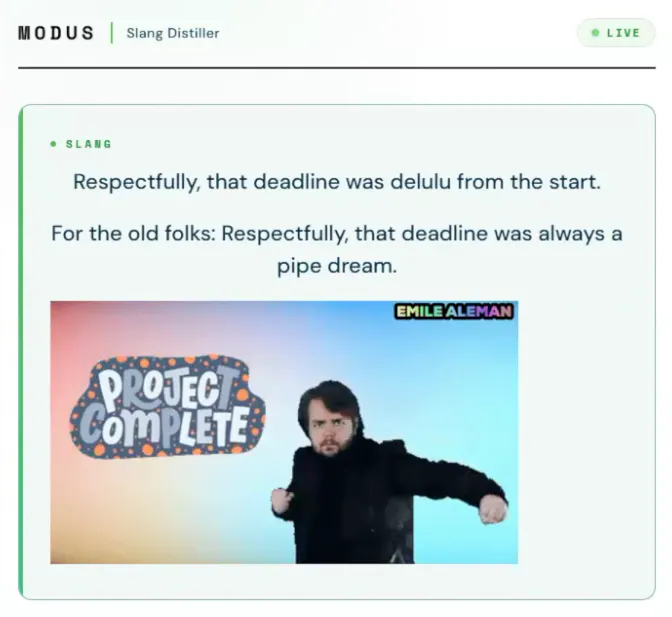
Team 1 built a fun, practical AI tool named the “Slangsplainer” that translates modern slang (especially Gen Z language) into clear, professional, or “corporate-friendly” language.
It’s designed for people who feel out of touch with newer slang and want quick, understandable translations. This helps bridge the generational communication gap.
“We wanted to be cool and hip, but we’re not — so we need help,” joked Gould, Team 1’s presenter. “We built this tool to translate the ‘vernacular of the children.’”
So, entering a quote like “Respectfully, that deadline was delulu from the start” into Slangsplainer will quickly translate the phrase into “Respectfully, that deadline was always a pipe dream,” complete with a GIF that illustrates the saying.
Looking ahead
Our Modus Makeathon series continues to explore the tools and techniques at the edge of what's possible in digital.


